Government Seeks Donor Support to Restore 10.6 Million Hectares of Degraded Land
By Eliud wainaina

The government has appealed to development partners, the private sector and local communities to invest in Kenya’s forestry sector, saying stronger partnerships are critical to restoring degraded landscapes, creating jobs and strengthening climate resilience.
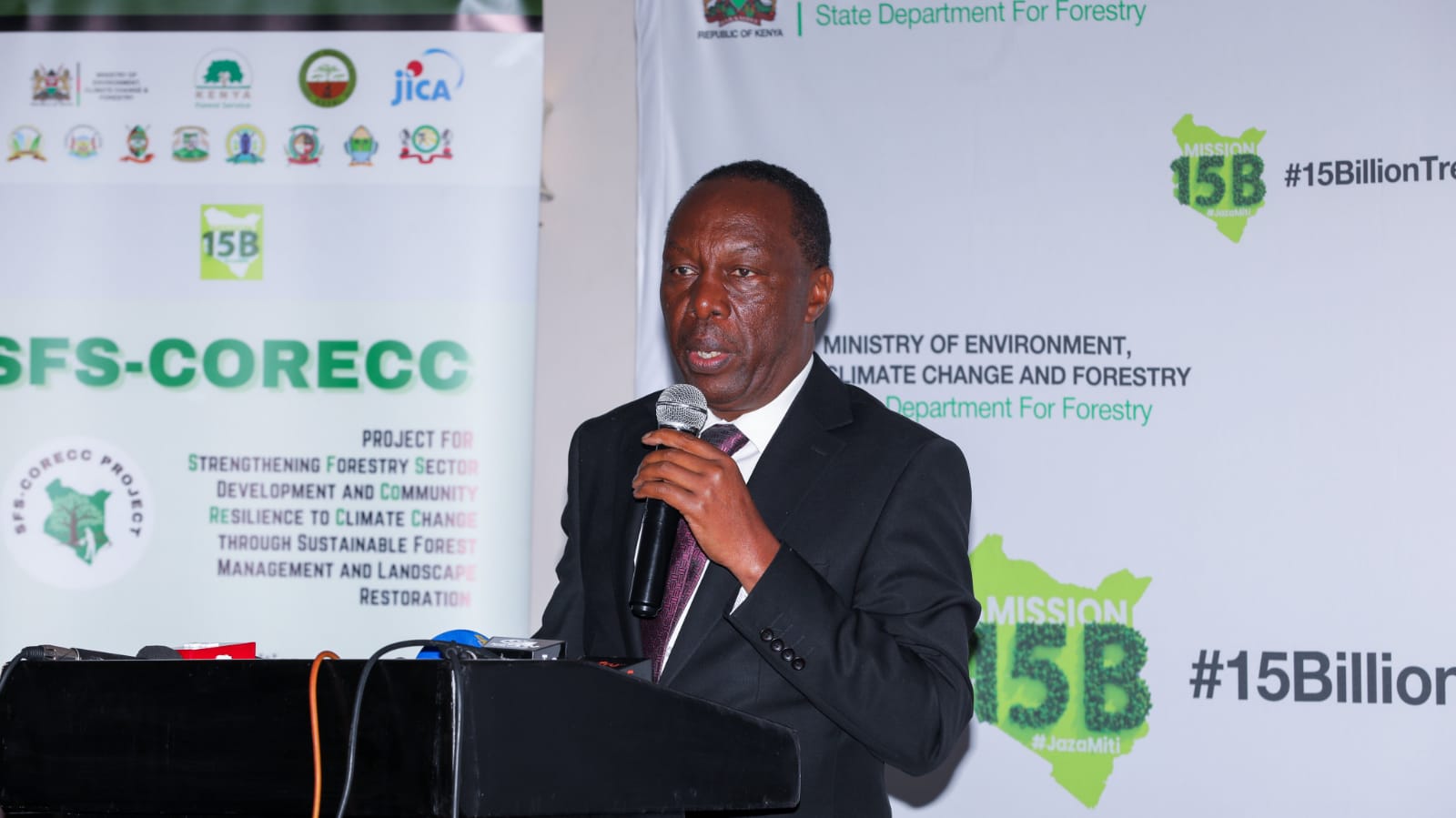
Speaking during a donors’ round-table breakfast meeting in Nairobi on Tuesday, Forestry Principal Secretary Gitonga Mugambi said the government cannot achieve its ambitious forest restoration targets alone and called for a collaborative approach involving county governments, communities, research institutions, civil society and development partners.
The meeting, organised by the State Department for Forestry in collaboration with the Japan International Cooperation Agency (JICA), brought together development partners, government officials and key stakeholders to discuss strategic investment opportunities in the forestry sector.
Mugambi said Kenya’s arid and semi-arid lands cover about 89 per cent of the country’s landmass and hold enormous potential for biodiversity conservation and sustainable economic development despite facing challenges such as land degradation, deforestation, desertification, recurrent droughts and climate change.
He said the government is implementing the National Landscape and Ecosystem Restoration Strategy 2023–2032, which aims to restore 10.6 million hectares of degraded landscapes while contributing to the national target of achieving 30 per cent tree cover by 2032.
“The restoration agenda is not only about protecting the environment. It is an investment in climate action, economic growth, poverty reduction, biodiversity conservation and sustainable livelihoods,” Mugambi said.
He urged development partners to increase investments that would help restore forests while creating employment opportunities for young people and women.
The PS said the government has shifted from relying solely on the Kenya Forest Service to a community-driven restoration model that empowers local communities to protect forests while improving their livelihoods.
He cited successful restoration efforts in Marakwet, where community-led initiatives have helped rehabilitate degraded landscapes, saying the model has already been replicated in other parts of the country.
“Communities are at the centre of forest restoration. When people have alternative sources of income, they become partners in conservation instead of drivers of forest destruction,” he said.
Mugambi also outlined plans to expand agroforestry as part of the country’s restoration agenda, with the government targeting the planting of one billion cocoa trees and one billion additional avocado trees to boost household incomes, create jobs and increase export earnings.
He said promoting fruit trees would improve food security while transforming forestry into a major source of economic growth.
The PS also called for investment in oil-producing crops to reduce Kenya’s dependence on imported cooking oil, urging partners to support the programme through seedling donations and financial contributions.
He highlighted innovative community projects that reduce pressure on forests, including modern livestock management systems where farmers keep cattle in designated feeding centres instead of grazing them inside forests, improving livestock productivity while protecting ecosystems.
Mugambi urged development partners attending the breakfast meeting to support community-based restoration initiatives, saying Kenya’s environmental future depends on sustained collaboration and long-term investment.
“Kenya belongs to all of us. By working together, we can restore degraded landscapes, improve livelihoods and build a more climate-resilient future for generations to come,” he said.