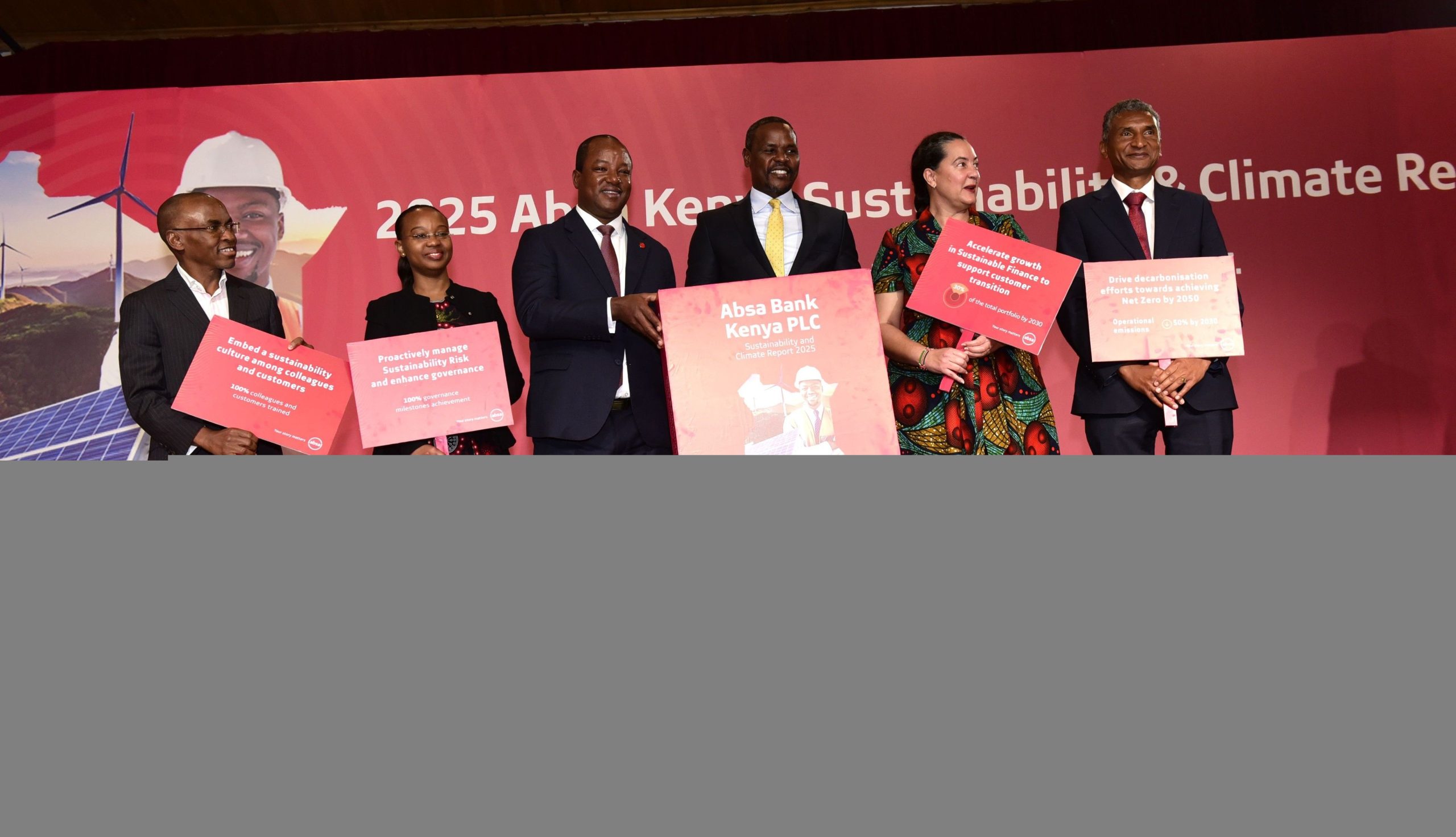
Absa Bank Kenya has disbursed more than KES 204 billion in sustainable finance between 2022 and 2025, reaffirming its commitment to accelerating financial inclusion, supporting enterprise growth, and financing climate-resilient development across Kenya.
According to the Absa Bank Kenya PLC 2025 Sustainability and Climate Report, the Bank advanced KES 55.3 billion in sustainable finance in 2025, up from KES 47 billion in 2024. Sustainable finance accounted for 30 percent of the Bank’s gross loan disbursements, significantly exceeding its annual target of 10 percent.
Of the total financing in 2025, KES 48.8 billion supported financial inclusion through funding for small and medium-sized enterprises (SMEs), women-led businesses, young entrepreneurs, and underserved communities. A further KES 6.5 billion was invested in climate finance, supporting renewable energy projects, green buildings, energy efficiency initiatives, and climate-smart agriculture.
Speaking during the launch of the report at Strathmore University, Absa Bank Kenya Interim Managing Director and Chief Executive Officer Yusuf Omari said the achievements reflect the Bank’s long-term commitment to delivering positive economic, social, and environmental impact.
“Our 2025 Sustainability and Climate Report highlights what we have achieved under our 2021–2025 sustainability strategy, which was anchored on 13 commitments aimed at creating shared value. We have intentionally deployed capital where it can make the greatest difference by supporting businesses, expanding access to affordable housing, financing climate-smart agriculture, renewable energy, and strengthening financial inclusion. We remain committed to partnering with our customers and stakeholders to build a more inclusive, resilient, and sustainable future for Kenya,” said Omari.
The report also highlights significant progress in the Bank’s environmental sustainability efforts. In 2025, Absa planted 283,969 trees, nearly four times the 72,000 trees planted in 2024, bringing the cumulative total to more than 1.5 million trees. The Bank also achieved a 96.4 percent waste recycling rate while reducing its operational energy consumption by 41 percent, supporting its journey towards net-zero emissions.
Beyond environmental initiatives, Absa continued to invest in social impact programmes aimed at empowering young people and strengthening communities. Nearly 38,000 young people received employability and entrepreneurship training through the ReadytoWork programme during the year, increasing the total number of beneficiaries to over 300,000. Meanwhile, the Absa Kenya Foundation reached more than 50,000 people through initiatives focused on education, entrepreneurship, skills development, and natural resource management.
The launch was attended by Dr. Festus Ng’eno, Principal Secretary in the State Department for Environment and Climate Change, who praised Absa for its leadership in sustainable finance and climate action.
“Climate change is already affecting livelihoods, infrastructure, ecosystems, and economic productivity. Investing in climate solutions is not only an environmental necessity but also a smart economic decision. Financial institutions have a critical role to play in expanding support for green enterprises, sustainable infrastructure, and climate resilience,” he said.
The report further notes that Absa has strengthened its climate governance and risk management framework by integrating climate considerations into lending decisions, enterprise risk management, and overall business strategy. These measures position the Bank to better support customers as they navigate the evolving challenges of climate change, technological transformation, and changing stakeholder expectations.
With more than KES 204 billion invested over the past four years, Absa Bank Kenya continues to position itself as one of the country’s leading financial institutions driving sustainable development, inclusive economic growth, and climate resilience.